
How many are criminals?
Probably more than you think...

How many are criminals? It’s a simple question to state, but upon moment’s thought, it becomes clear that there is no simple answer. Nearly everyone has technically committed a minor inconsequential offense at some point, yet “nearly everyone” would be a misleading answer. Obviously, people have more serious offenders in mind when they think of “criminals”, so the question must be answered according to a stricter operationalization. For instance, in the United States, we might consider those people who, at some point in their life, are convicted of a felony.
If you have read an earlier article of mine, or you have a grasp of criminology, you may know that a large portion of crime is due to a small number of repeat offenders. From this you might infer that there are very few criminals — but that would be a mistake. Yes, a few repeat offenders account for a large share of crime, but there are many more criminals who each have a small number of offenses under their belt.
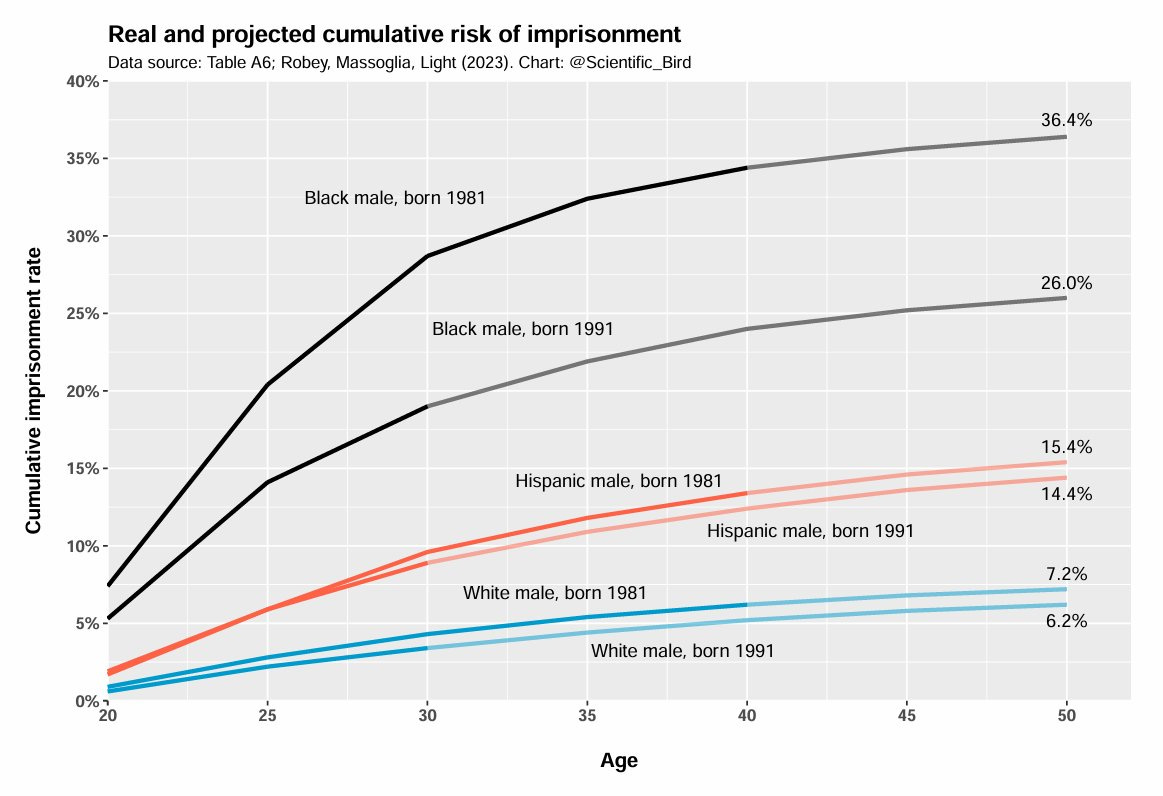
To address the question head on, consider the proportion of men in the United States who eventually end up in prison (Robey et al., 2023).
People don’t end up in prison for trivialities. Prison, as opposed to jail, is designed for long-term incarceration—prison sentences in the United States are rarely shorter than a year. Jails are where people are held while awaiting trial or sentence, or while serving short sentences.
As the figure above shows, one in four to one in three black men eventually end up in prison. The same is true for one in seven Hispanic men, and about one in fifteen (non-Hispanic) white men.
These high figures left many in disbelief when I posted them a little while back. Surely this included jail, or something else was off, right? But no, it really is that many.1
If you think this is because the United States is some huge outlier, you might be in for a surprise. In Sweden, a study found that 1% of the population was responsible for 63% of violent crime convictions. But the same study also showed that ~7% of men were convicted of a violent crime in their lifetime (Falk et al., 2013). One in fourteen men in Sweden, convicted of a violent crime.2
In Denmark, depending on birth cohort, about 6–7% of men receive an unsuspended prison sentence at some point in their lifetime (StatBank, STRAFFO2). In the same birth cohorts, about 7–9% of men are eventually convicted of a violent crime (StatBank, STRAFFO1).
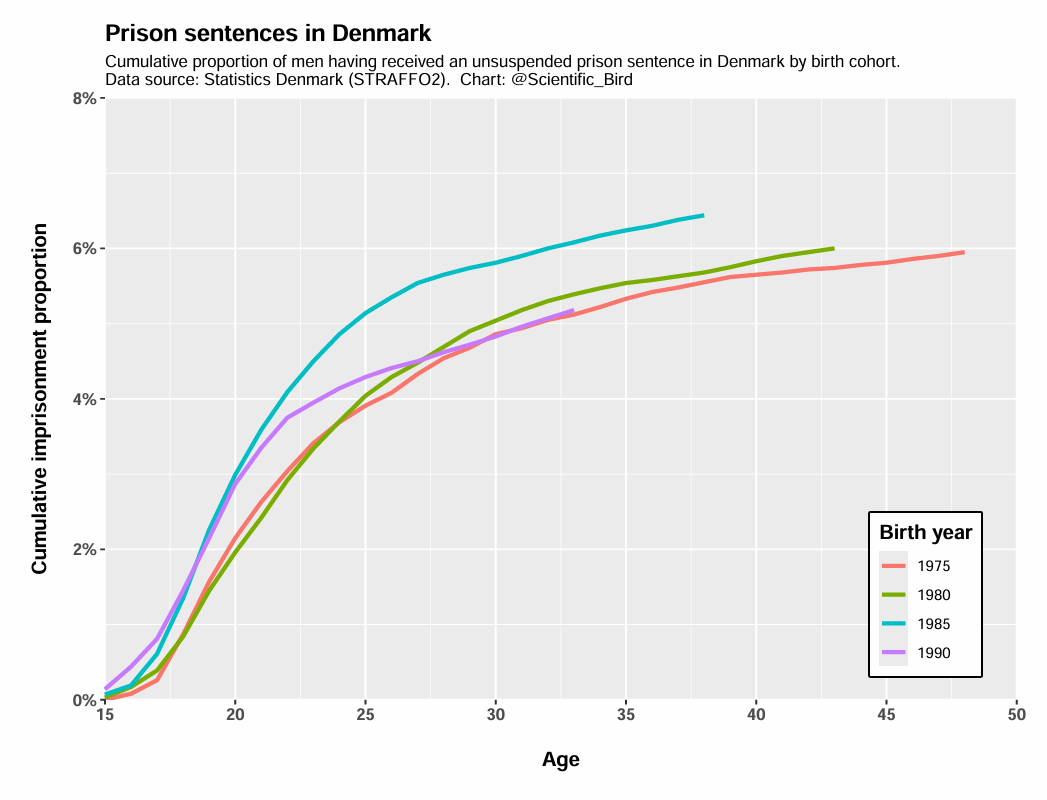
This also provides a clue as to why the American prison population is so comparatively large (per capita). It is not just because they imprison more people but, probably more importantly, because American prison sentences are much longer. Whereas prison sentences are typically more than one year in the United States, the modal length of an unsuspended prison sentence is one to two months in Denmark (StatBank, STRAF47). This leads to a much larger share of American people being imprisoned at any given time.
If we consider all crimes under the Danish criminal code, which includes a larger number of offense types but still excludes minor traffic offenses, the number of criminals increases markedly. We also see large ethnic disparities.
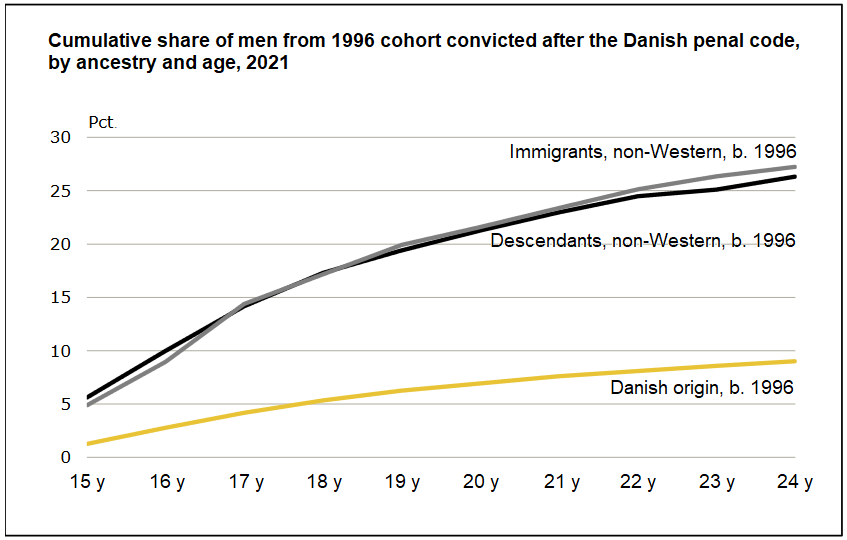
As shown in the figure above, already by age 24, about 9% of men of Danish origin and 27% of men of non-Western origin have been convicted under the criminal code.
Thus the common refrain that only a tiny, insignificant share of immigrants commit crime is clearly false. It is not true for native Danes, and it is even less true for many immigrant groups.
In summary, while it is certainly true that a large share of crime is committed by a small number of persistent offenders, there are still more criminals than you might expect.
The cited study addresses this directly. As the authors write: “All data sets on the incarcerated population exclude jail inmates and admissions to local jails.”
As the study shows, 93,642 out of 2,393,765 (or 3.9%) were convicted of a violent crime. The paper additionally reports that 83,524 out of the 93,642 (89.2%) convicts were men. If we assume that ~49% of the age-relevant population are males, then 100% × 83,524/(2,393,765×0.49) = 7.1% of men were convicted of a violent crime. The study excludes (foreign-born) immigrants. It does include descendants of immigrants, but this would have negligible statistical impact considering the population analyzed are those born 1958–1980.
"the modal length of an unsuspended prison sentence is one to two months in Denmark"
Does that mean comparing Danish prisons to prisons in the USA is an apples-to-oranges comparison?
In the USA, short sentences are served as jail time, while longer sentences are for prison (typically a year). But in Denmark maybe they don't have this distinction?
“it is certainly true that a large share of crime is committed by a small number of persistent offenders, there are still more criminals than you might expect.”
Gee, I wonder why. Must be racism on the part of the host country. ;-)