
How northwest Europe attained modern homicide rates already by 1750
The long-run decline of violence in Europe, and why poverty is not responsible for violent crime

If we travel sufficiently far back in time in Europe, we encounter homicide rates vastly exceeding what we’re used to. A classic illustration is found in the English long-run homicide rate estimates by Eisner (2003):
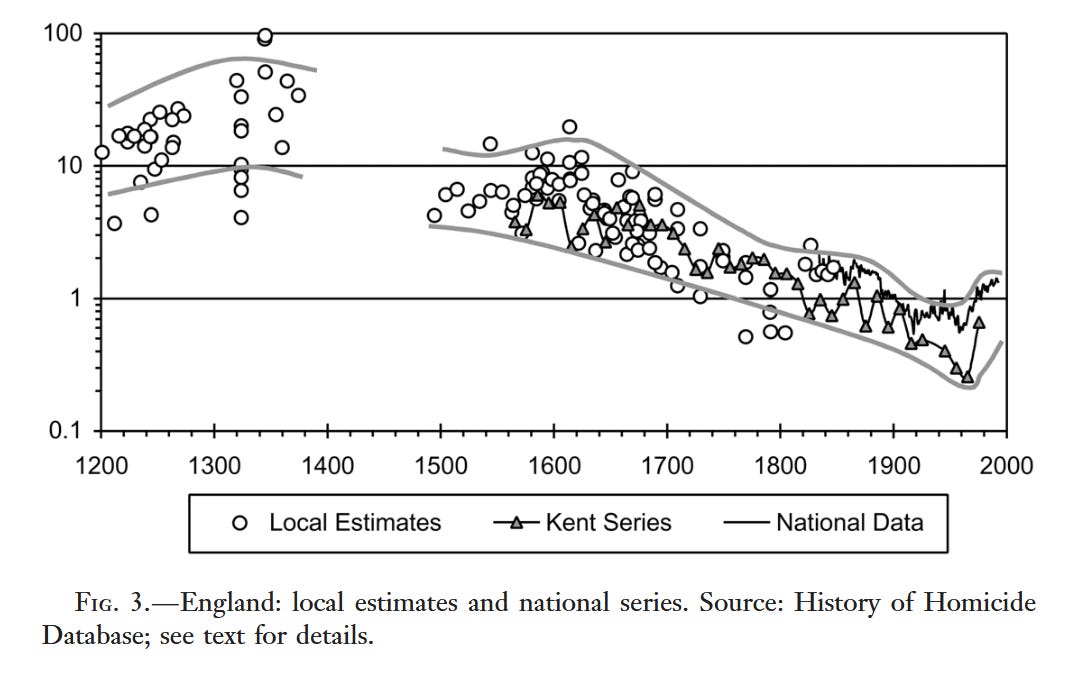
These estimates suggest a homicide rate of approximately 20 homicides per 100,000 inhabitants in England in the 14th century (note the logarithmic axis). While these local estimates contain substantial uncertainty, the massive downward trend cannot be doubted.
Today Western European homicide rates tend to hover around ~1 homicide per 100,000, and have thus declined by more than an order of magnitude. (For comparison, the American homicide rate has been 4-7 per 100,000 in recent years.)
It is rarely mentioned that long-run homicide trends pose a serious challenge to the belief that poverty is the mother of crime. The homicide rate decline preceded the economic growth of the Industrial Revolution. When the West eventually did grow rich, it wasn’t met with additional widespread decline in homicide.
Sweden, for instance, has experienced a ~30-fold increase in GDP per capita from 1750 to 2022, and yet the homicide rate showed no systematic decline over that period. How could this be if the absolute economic level of a country plays a central role in determining violence? A “violence isn’t monocausal”-retort is hardly convincing—the economic transformation is far too large to shrug off so casually.
These observations are all the more astonishing in light of population aging (violence is a young man’s game), and medical and emergency advances that have made it far easier to save the life of an injured person.1
In this piece, I will analyze the data on long-run homicide trends in greater detail. When did homicide rates reach modern levels? And where did homicide rates decline first? The data provide insight into the deep roots of regional disparities in violence, and conflict with popular ideas about causes of violence.
Keep reading with a 7-day free trial
Subscribe to Patterns in Humanity to keep reading this post and get 7 days of free access to the full post archives.