
Euler, enlightenment genius
The talents and personality of the most prolific mathematician in history

Introduction
The prodigious mental abilities exhibited by geniuses throughout history are both fascinating and awe-inspiring. Many well known (some possibly apocryphal) stories speak to the remarkable abilities of Carl Friedrich Gauss, John von Neumann, and several others. Recently I saw someone comment that they had never heard such a story about Euler. That’s a good excuse to finally write a little about the man.
Leonhard Euler (1707–1783) was the greatest mathematician and physicist of the 18th century and the most prolific mathematician of all time.1 The depth and breadth of his contributions to mathematics and physics are so great that they are difficult to convey. In his eulogy to Euler, Marquis de Condorcet (1743–1794) spoke of the “impossibility . . . of conveying in detail . . . an accurate idea of the multiplicity of discoveries, new methods of investigation, and ingenious views” contained in his work.2
This short piece is not about that work, but about the man behind it: his talents and personality. By all accounts, Euler had an extraordinary memory and capacity for mental computation which, together with an unstoppable drive, made possible this uniquely prolific career. His personality was also a refreshing contrast to the stereotype of the neurotic and isolated genius. His work, intellectual ability and personality all made a great impression on his contemporaries and he died as a revered celebrity.
A blossoming talent
Leonhard Euler was born in 1707 in Basel, Switzerland. As a boy, he was cheerful, sociable and highly talented, though the term “prodigy” has not as routinely been applied to him as with, say, Gauss. This, however, must partly be understood in light of his lack of early dedicated mathematical training. After all, Leonhard’s father wanted his son to become a pastor; and his upbringing and early education reflected that.
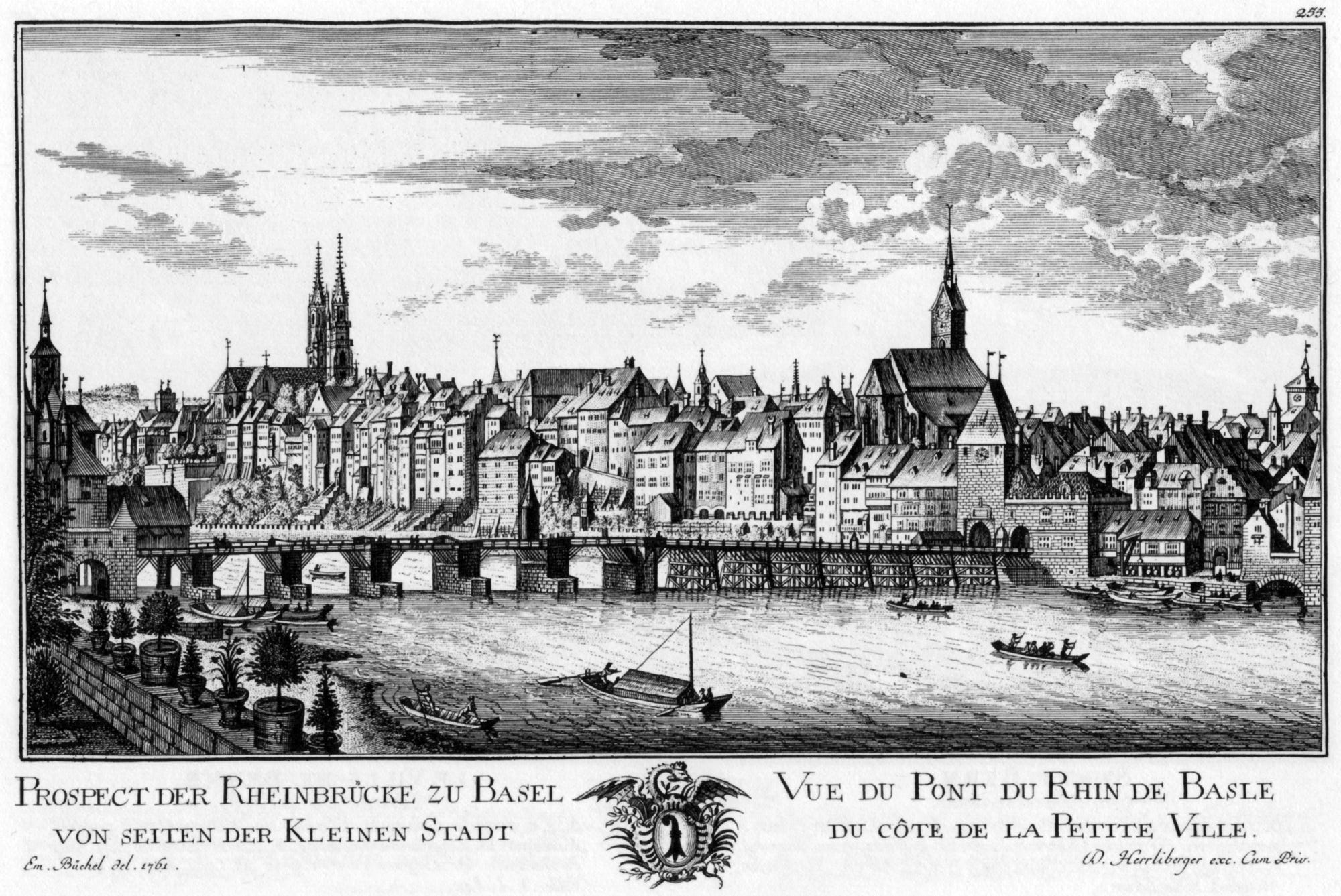

Nevertheless, Euler did receive basic instruction in mathematics from his first teachers: his parents. As a boy, his father gave him an old-fashioned algebra textbook from the 1500s. This book must’ve been extremely difficult to work through for the little child. As Euler-biographer Ronald Calinger notes: “[A]t just seven years of age, only an exceptional child could have hoped to make it through such a difficult text.”3 But little Euler was exceptional.
Seeing that he had extraordinary intellectual ability, the 8-year-old Leonhard was sent by his parents to live with his maternal grandmother so he could attend the Latin grammar school (a Gymnasium) in Basel.4 The Latin school offered little to no mathematics instruction, though Leonhard’s father hired in 1715 a theologian tutor with a tolerable background in mathematics for private lessons.5 In 1720, 13-year-old Euler registered at the University of Basel for courses in the philosophical faculty.
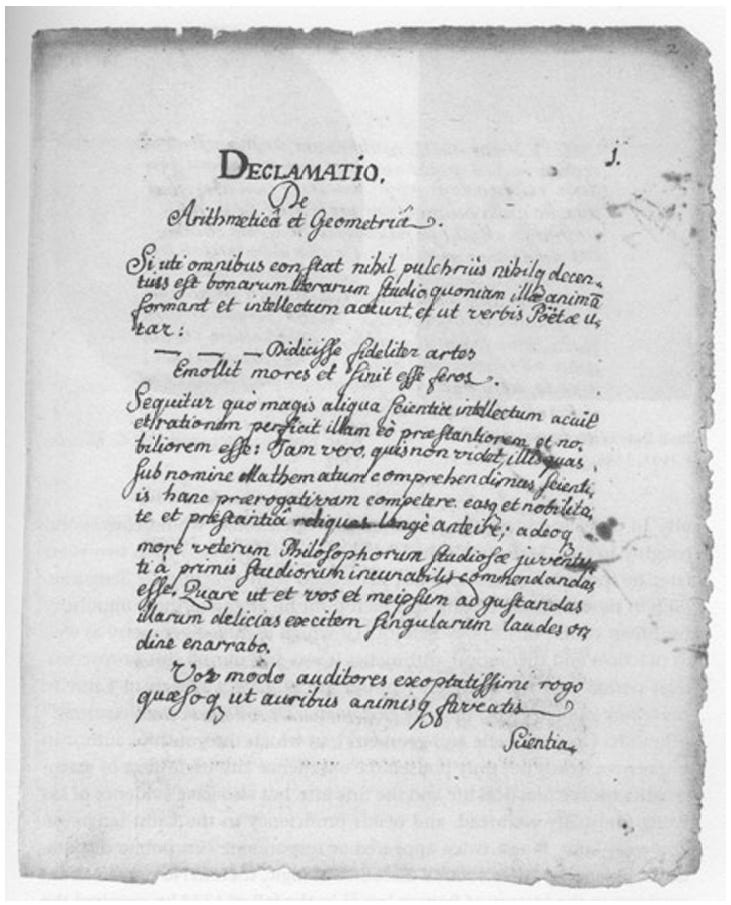
Euler mastered all his subjects in university through hard work and an astonishing memory. His memory was a gift for acquiring languages. At age 14, the young Euler gave a speech in Latin on arithmetic and geometry. The year after, he was appointed three times to exchange views publicly about Latin papers.6
As part of the standard Latin curriculum, Euler was also exposed to Virgil’s Aeneid. He learned this epic poem entirely by heart:
He now displayed his eidetic memory by reciting long passages from Virgil’s Aeneid, which contains more than ninety-five hundred verses and which he knew entirely by heart. Even at the age of seventy, he could cite the beginning and closing words on each page of the text he had read as a young man.7
In 1723, the 16-year-old Euler passed the examination for his master of arts degree.8 At the graduation session, he gave a public lecture in Latin comparing the natural philosophy of René Descartes with that of Isaac Newton and indicating the consequences of each.9
Young Euler had a knack for solving mathematical problems with only minimal external assistance. Starting in October 1723, he had weekly meetings with the famous Basel mathematician Johann Bernoulli (1667–1748). “Private lessons, however, he [Johann Bernoulli] categorically ruled out because of his busy schedule,” says Euler in his short autobiography, however:
[H]e gave me a far more beneficial advice, which consisted in myself taking a look at some of the more difficult mathematical books and work through them with great diligence, and should I encounter some objections or difficulties, he offered me free access to him every Saturday afternoon, and he was gracious enough to comment on the collected difficulties, which was done with such a desired advantage that, when here solved one of my objections, ten others at once disappeared, which certainly is the best method of making auspicious progress in the mathematical sciences.10
“This instilled an excellent process,” said Nicolas Fuss (1755–1826), mathematician and later assistant of Euler, “but only one that can succeed with an extremely talented genius which Mr. Euler possessed.”
In line with his family’s wishes, Leonhard Euler began studying theology in 1723. It was probably Bernoulli who in 1725 helped convince Leonhard’s father that his son’s true calling was mathematics. Johann Bernoulli (who was the most highly regarded active mathematician at the time11) now considered his 18-year-old student a genius who alone was worthy to be his successor. He described Euler as possessing the highest acumen, together with the mental agility and ingenuity, to be able to penetrate the most profound secrets of higher mathematics.12
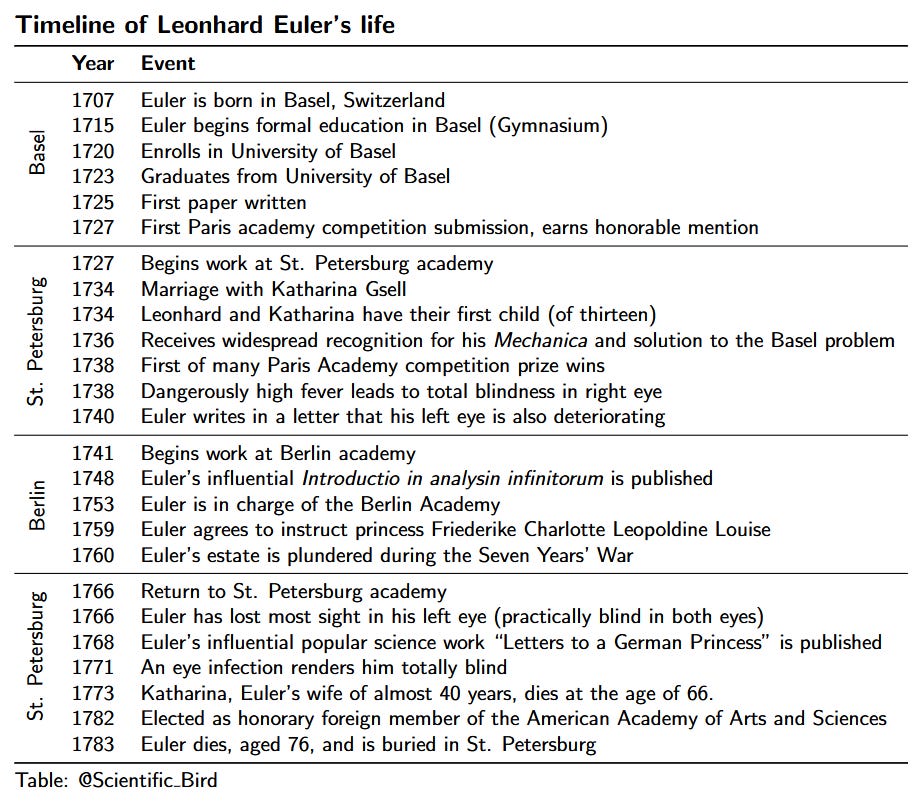
Once he received his father’s blessing, and once his full attention was devoted to mathematics and science, Euler’s genius could truly flourish. He began independent investigations at the age of eighteen and had his first paper published in 1726. The following year Euler participated in the prestigious Paris Academy science competition which proposed for 1727 the problem of the most efficient arrangement of masts on a ship. Having grown up in a landlocked country with no practical experience with ships, it was impressive that the 19-year-old Euler’s essay managed to secure an honorable mention (practically speaking a second place finish). Euler would, in time, go on to win the prestigious prize more times than any other individual.13
It was also in 1727 when Euler was hired by the St. Petersburg Academy in Russia, where he was eventually appointed an adjunct of higher mathematics. This marked the beginning of his long and prolific career in mathematics and natural philosophy.
In St. Petersburg, Euler had two early breakthroughs in the years 1735–1736 which brought him considerable fame. First he solved the famous Basel Problem, a problem concerning the sum of the reciprocals of squares that had stumped the leading mathematicians for half a century. Secondly, he also published Mechanica (1736), a widely praised book that was the first one on mechanics entirely in the language of the new calculus. His reputation was further bolstered by Paris Academy competition prize wins in both 1738 and 1740. In 1741 he began working in the Berlin Academy in Prussia, and in 1766 he returned to the St. Petersburg Academy once again where he stayed until his death in 1783.
Euler, the person
Euler was in many respects the polar opposite of the prevalent mathematics genius stereotype. He was not neurotic, isolated or introverted. He was cheerful and sociable, generous and kind, and always humble. He also enthusiastically took on the role as teacher (unlike, say, Gauss or Newton).
Nor was Euler the stereotypical lifelong bachelor. He had a long and healthy marriage. He and his wife together had thirteen children (of which, sadly, only five survived past early childhood), and the children were a great source of happiness for Euler.14 For entertainment, he and his wife enjoyed taking their children to the zoo and marionette shows. On the rare occasion that there was any time for leisure, Euler enjoyed chess and playing the clavier. He was also an ardent pipe smoker.15
Despite giving up becoming a pastor, Euler remained a wholehearted believer and closely followed the religious practices of his upbringing until his death. Before bed, Euler would often read Biblical passages for his children.16 His unshaken Christian conviction was occasionally the target of criticism from the contemporary French Enlightenment philosophers, but thick-skinned Euler took it in stride.
It was not just his work and talents that made an impression on his contemporaries; his personality did as well. As a person, Euler was described as:
ascetic; always ready to engage in conversations, with the rare ability to shift immediately from deep discussion to a casual level and back; gentle and cheerful, enjoying harmless jokes; good-hearted and fair, refusing to hold grudges. Euler, Fuss avowed, had been an incomparable teacher; the student recalled a scholar devoutly religious, unmarked by the skepticism and the crisis of conscience that often went with the mentality of the Enlightenment. He was also hailed as a good husband, father, and friend.17
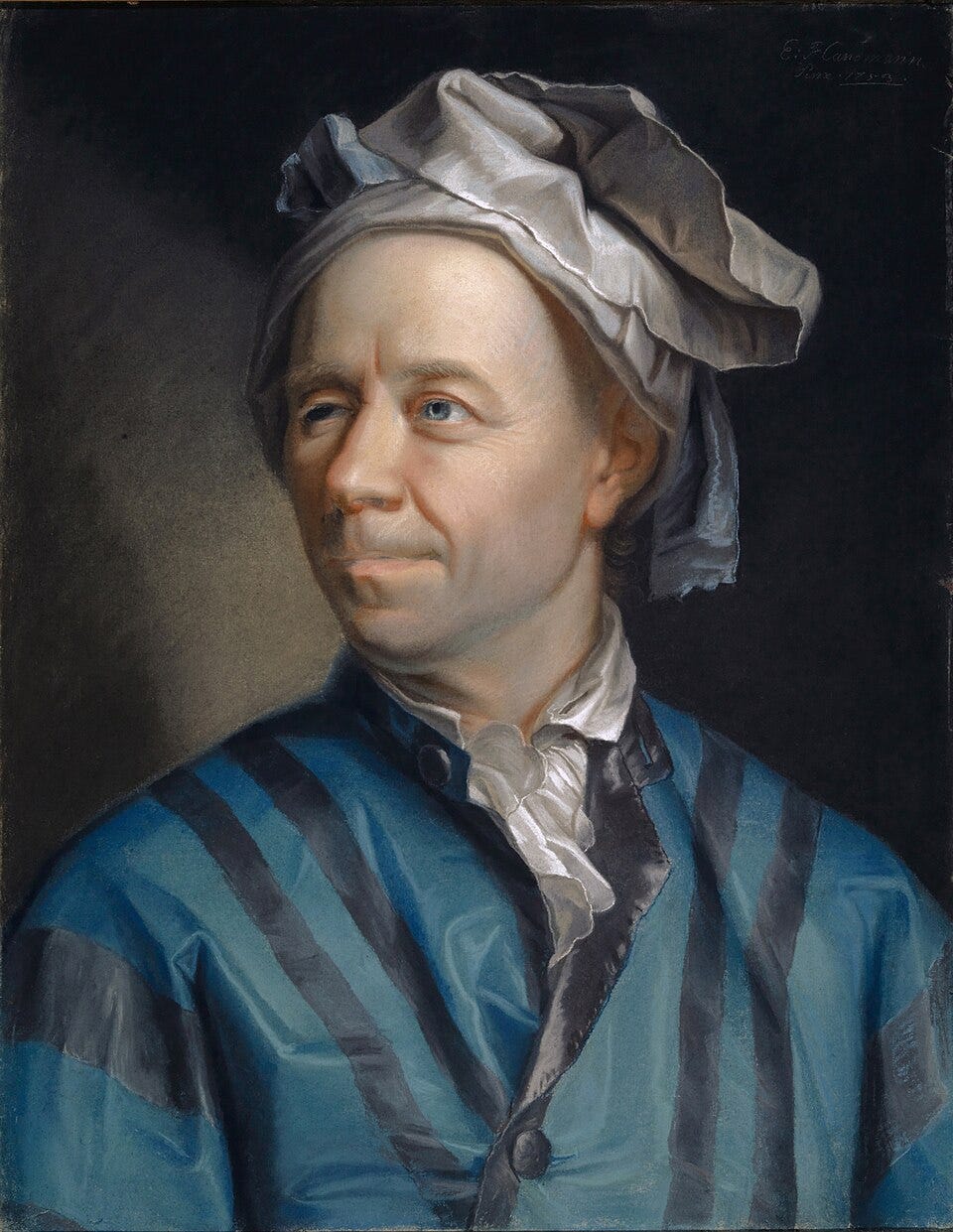
In 1738, a dangerously high fever led to total blindness in Euler’s right eye. But he was not perturbed. Some years later, Euler wrote a letter expressing joy about life in Berlin:
After having left the Petersburg Imperial Academy, I have every reason to be satisfied with my lot. . . . I can do just what I wish [in my research] and no one expects anything from me. The king calls me his professor [mon professeur] and I think I am the happiest man in the world.18
Over the years, his vision also gradually disappeared in the left eye. By the time he was 60, he was practically blind in both eyes. His good spirits persisted despite this: “One more distraction removed,” he said about the loss of his vision.19
A living computer
Euler’s blindness only made his exceptional abilities and tenacity all the more unmistakable—the condition had no apparent effect on his productivity. Aided by scribes, Euler wrote an average of one mathematical paper per week in the year 1775. As remarked by William Dunham, “Never was his remarkable memory more useful than when he could see mathematics only in his mind’s eye.”20
Contemporaries repeatedly commented on his extraordinary memory and aptitude for mental calculation: “[H]is memory did not permit him to forget anything,” said Condorcet in his eulogy dedicated to Euler. He had a “prodigious memory which loses nothing from a lecture he has heard,” according to Fuss.
As previously mentioned, Euler had learned the entirety of Virgil’s epic poem Aeneid by heart as a teenager. Even when he was seventy, he could cite the beginning and closing words on each page of the text he read when he was young. Ready on demand, Euler had access to enormous formulae and vast tables of numbers in his mind’s eye. For making the calculation of roots easier, he apparently memorized the first six powers of all natural numbers up to a hundred (i.e., n², n³, …, n⁶ for all n = 1 to 100).21
Euler clearly took pleasure in calculating. Various mathematical constants (π, e, ζ(2), etc) were calculated by him to many digits of precision. He discovered the then largest known prime which no one surpassed for nearly a century. He was also able to factorize 2³² + 1 as 641 × 6,700,417, thereby disproving Pierre de Fermat’s conjecture that it was a prime number. These are remarkable feats without access to modern computing tools.
The man was, of course, not merely a mindless computer. As a great mathematician, Euler often saw connections that no one else had. For the prime factorization, he proved that any composite “Fermat number” must have a particular structure; this drastically reduced the search space for possible factors. Similarly, on his quest to solving the Basel Problem—finding the exact sum of 1 + 1/2² + 1/3² + 1/4² + etc—he estimated the value of the sum so accurately that it would require summing the first 30,000 terms of the original series had it been done through naïve computation.22 Instead of doing brute force calculation, Euler invented a method now called Euler-Maclaurin summation which required far fewer terms to reach the desired accuracy.
Euler’s peers were frequently amazed by his ability to calculate. One notable incident happened while Euler was working in the Saint Petersburg Academy, where he was tasked with a project requiring astronomical calculations. He astonished the academicians by completing in three days a task they expected might take three months.23
Euler could perform incredible calculations entirely in his head. Two of Euler’s pupils (as we are told by Fuss, pupil himself) had one day calculated a converging series as far as the seventeenth term. Upon comparing their written results, they found a discrepancy at the fiftieth place. They communicated this difference to their master, and the blind Euler made the correct calculation in his head.24
Euler was also a man of extraordinary erudition. People were amazed by the breadth of his knowledge outside his area of expertise. According to Marquis de Condorcet, “Euler had studied nearly everything available in the branches of Physics, Anatomy, Chemistry and Botany.” Nicolas Fuss, who served as an assistant for the blind Euler, wrote:
He possessed what is called erudition to a very important degree. All that is left to us by the great writer of ancient Rome, he read; old mathematical manuscripts were perfectly known to him; the history of all the ages and nations were found in his head and he knew to quote whatever he knew without mistakes. He was familiar with medicine, botany and chemistry; he knew much more than was expected of a scientist whose science was other than the ones he knew so well.
Respect and admiration
Not all great men receive due recognition in their lifetime, but Euler did. Near the end up his life, Euler’s reputation had extended far beyond the scientific community. Of all 18th century intellectuals, Euler’s fame reached a status that was second only to that of Voltaire.
Early in Euler’s career, Johann Bernoulli addressed Euler in a letter as the “most famous and learned man of mathematics.” When Euler returned to the Saint Petersburg Academy in 1766, Catherine the Great wrote in a letter:
I am certain that the academy will be resurrected from its ashes by such an important acquisition, and congratulate myself in advance in having restored this great man to Russia.25
In his final years, Euler’s home became something of a tourist attraction. Strangers and notable people visited and spoke with him about non-mathematical topics, experiencing the venerable old man’s erudition. Visitors left his home with “surprise mixed with admiration” that he “could have retained so many facts, much of which was unimportant and useless to the pursuit of his studies,” remarked his assistant.26 In 1782, one year before his death, Euler was made an honorary foreign member of the American Academy of Arts and Sciences.
One final heartwarming anecdote is worth telling. In 1783, the final year of Euler’s life, princess Yekaterina Romanovna Dashkova (1743–1810) was appointed as the director of the Russian Imperial Academy of Sciences by Catherine the Great. On her way to the inauguration, the princess stopped to visit at home the man she called Euler the Great. She begged Euler to let her enter the academy on his arm, and he was honored to do so. Euler, his son, and his assistant together accompanied princess Dashkova on the horse carriage to the ceremony.27 At the ceremony, after noticing that the seat of honor had been taken, Dashkova (as related in her memoirs) treated Euler with the utmost respect:
I [Princess Dashkova] therefore turned to Mr. Euler and told him to sit down wherever he thought fit, for any seat he occupied would always be the first among all. His son and grandson were not alone in showing appreciation . . . at my remark, and the professors, who all had the highest respect for the venerable old man, had tears in their eyes.
With support from Catherine the Great, the Petersburg Academy offered tribute to Euler by bestowing on him alone the grand medal of the academy and commissioned a mural in the assembly hall in his honor.28
The 76-year-old Euler died not long thereafter. On the morning of 17 September 1783, Euler instructed his brightest grandson in the sciences. Still equipped with a sharp mind, he also made some difficult mental calculations about the motion of hot-air balloons. In the afternoon, Euler started joking and playing with one of his grandsons while sitting on the couch with his pipe. Suddenly, he suffered a stroke and dropped his pipe. “My pipe!” he exclaimed, “I am dying.”29
The statement that Euler was the greatest mathematician of the 18th century is uncontroversial. He is also widely regarded as the most prolific contributor to mathematics. While Paul Erdős was author of more papers (often with collaborators), Euler produced more pages worth of groundbreaking mathematics than anyone else (and did so largely as single author). Though Euler is more famous as a mathematician, he was also an excellent and important physicist. Truesdell, for instance, writes: “While EULER is known today primarily as a mathematician, he was also the greatest physicist of his era, a rank which was obscured for 200 years but has been re-established by the recent studies of Mr. DAVID SPEISER.”
Ronald Calinger, Leonhard Euler: Mathematical Genius in the Enlightenment, p. 114.
The book was Michael Stifel’s enlarged second edition (1553) of Rudolff’s Coss (1525). See Ronald Calinger, p. 13-14.
Ronald Calinger, p. 14.
Ronald Calinger, p. 15.
Ronald Calinger, p. 17.
Ronald Calinger, p. 22.
In Euler’s time, it was not unusual to graduate university at this age. In general, people had far fewer years of education and thus completed education earlier than today.
Ronald Calinger, p. 19.
Euler’s autobiography dictated to his son. Quoted from Fellmann’s Leonhard Euler.
Leibniz and Jacob Bernoulli were now both dead, and Newton was no longer an active research mathematician.
Ronald Calinger, p. 25.
Ronald Calinger, p. 147.
Ronald Calinger, p. 189.
Ronald Calinger, p. 283.
Ronald Calinger, p. 188.
Ronald Calinger, p. 533.
Ronald Calinger, p. 454.
Ronald Calinger, p. 238.
William Dunham, Euler: The Master of Us All, p. xxvi.
Ronald Calinger, p. 95.
Ronald Calinger, p. 115.
Ronald Calinger, p. 448.
Bogoliubov et al., Euler and Modern Science
Ronald Calinger, p. 528.
Ronald Calinger, p. 529.
Ronald Calinger, p. 531.